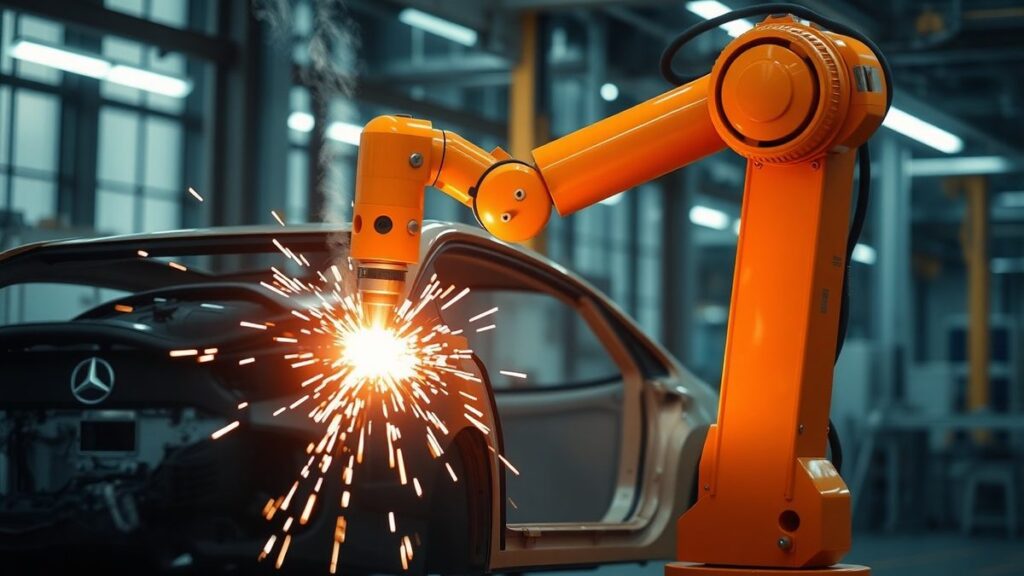
A business and engineering problem worth studying
Beneath the surface of every modern vehicle is one of the most fascinating business and engineering problems in industry: how to integrate dozens of subsystems from hundreds of suppliers into a product that is affordable, reliable, safe, and ready for mass manufacturing. That integration challenge is what makes the automotive industry such an interesting case study for any operations leader. The same problems that automakers have spent a century solving — supplier coordination, quality at scale, design-for-manufacture, complex regulatory compliance — show up in slightly different forms across most physical-product industries, and increasingly in software ones too.
The industry is also where some of the most influential operational practices in modern business were born. Statistical process control, just-in-time inventory, lean manufacturing, platform engineering, design for assembly — concepts now standard across pharmaceuticals, retail, technology, and even healthcare — were largely refined or invented in automotive plants. Understanding where these practices came from, and why they worked, helps explain why they continue to spread.
The Toyota Production System: where most modern operations thinking begins
The single most influential operational framework of the past 75 years is the Toyota Production System (TPS), developed at Toyota starting in 1948 by Sakichi Toyoda, Kiichiro Toyoda, and Taiichi Ohno. The system rests on two conceptual pillars. Just-in-time production — making only what is needed, when it is needed, in the amount that is needed — minimizes inventory and surfaces problems quickly. Jidoka — automation with a human touch — empowers any worker to stop the line when they detect a defect, preventing problems from compounding downstream.
What’s striking about TPS history is its origin. Toyota engineers didn’t borrow the just-in-time concept from American automakers (the largest in the world at the time); they got the idea from visiting an American supermarket — a Piggly Wiggly, specifically — and observing that goods were only reordered after customers bought them. The supermarket replenishment model became the conceptual foundation for revolutionizing global manufacturing. Some of the best operational ideas come from outside the industry trying to apply them.
The principles that travel beyond automotive
Several TPS principles have proven remarkably portable to other industries.
Eliminating waste systematically. TPS identifies seven categories of waste — overproduction, waiting, unnecessary transport, over-processing, excess inventory, unnecessary motion, and defects. Auditing operations against this taxonomy and removing waste deliberately is a discipline that works in factories, hospitals, software development, professional services, and call centers.
Kaizen — continuous improvement. Small, consistent improvements compound over time more reliably than large, infrequent transformations. The companies that adopt kaizen genuinely — rather than as a slogan — typically out-execute competitors over multi-year periods even when individual quarters look unremarkable.
Genchi Genbutsu — go and see for yourself. The principle that managers should physically observe operations rather than rely on reports. This pushes back against management-by-spreadsheet and forces leaders to encounter the actual texture of the work. Companies that have adopted this principle in customer-facing operations — having executives staff support lines for a day, work alongside production teams, sit in on user research — consistently make better decisions than those that rely only on summary data.
Andon — empowering anyone to stop the line. Granting frontline workers the authority and obligation to halt production when they see a defect, rather than passing the problem downstream. The equivalent in software is anyone being able to revert a deploy; in healthcare, anyone being able to call a time-out before a procedure; in services, anyone being able to escalate a customer issue without permission.
Platform engineering: managing complexity by sharing it
One of the most consequential operational practices to come out of automotive is platform engineering — designing common underlying architectures that support many product variants. A modern vehicle “platform” includes the chassis, suspension geometry, electrical architecture, and software framework that multiple distinct vehicle models share. The Volkswagen MQB platform underlies dozens of VW, Audi, Škoda, and SEAT models. Toyota’s TNGA platform supports the Camry, RAV4, Highlander, and Lexus variants.
The economics of this practice are powerful. Engineering investment is shared across multiple product lines. Component sourcing benefits from greater scale. Manufacturing flexibility increases. The same logic is now reshaping software (platform teams that build shared infrastructure for product teams), consumer electronics (Apple’s silicon architecture across iPhone, iPad, Mac), and pharmaceutical research (modular drug discovery platforms). The companies pulling ahead in many industries are doing what automakers learned decades ago — investing heavily in shared platforms that compound across products.
How automotive is being reshaped by software
The current transition in automotive is partly about electrification, but the more durable change is the shift from hardware-defined to software-defined vehicles. Cars now ship with capabilities that can be added, modified, or even sold as subscriptions through over-the-air updates. The differentiation between vehicles is increasingly in software experience — driver assistance, in-cabin AI, navigation, entertainment — rather than purely mechanical characteristics.
This shift has produced a culture clash inside legacy automakers. Software development cycles are weeks; hardware development cycles are years. Software engineering hiring competes with technology companies for the same talent at salaries automotive companies haven’t traditionally paid. The organizational design challenge — building genuine software capability inside companies that were structured for mechanical engineering — has been the largest internal challenge for legacy automakers in the past decade. The companies that solved it (Tesla pioneered the pattern; BYD and other Chinese automakers have applied it aggressively) are extending their lead. Those still treating software as a peripheral feature are falling behind in the markets that matter most.
What other industries can still learn
For business leaders outside automotive, the lessons available from the industry continue to compound. Some of the most useful operating practices come from industries you don’t currently work in. The companies that adopt these techniques early often gain advantages their competitors don’t notice until much later.
Reading widely across industries — not just within your own — is one of the cheaper and more reliable ways to find such advantages. The Toyota Production System didn’t stay in factories; it reshaped how hospitals handle patient flow, how software teams deploy code, and how restaurants prepare meals. The current automotive transition to software-defined products is reshaping how every physical-product industry thinks about post-sale revenue, feature differentiation, and customer relationships. Watching how automotive companies handle these transitions is useful even if you sell something completely different. The lessons travel.